
Essentials of Competitive Bodybuilding THE WORKOUT JOURNAL I find it useful to keep a written record of my workouts. After each workout I write out all of my exercises, the weights I used and how many reps I did with each weight. I also write down how I felt during the workout: did I get a good pump, did I lack energy, did I sustain an injury, was I distracted, etc. I prefer doing this at home following the training session, rather than between sets at the gym, because the latter way would interrupt the flow of my workout.
The journal is useful because I can see exactly what I've done on paper, and I can measure my progress this way. The journal should be reviewed every week to give you a good idea of how you are doing and what you plan to do. Resolve to do better! TRAINING PARTNER Training with a partner has several advantages. Your training becomes easier because you have someone to push you in your workout. It also makes training more interesting because competition is involved. Whenever I'm in training for a competition, I always try to find a training partner because I know I'll train harder. When choosing a training partner, pick one who has a similar structure to yours and similar weak points. Agree upon the training program and the time of day, and how often you will train beforehand. Encourage each other while you train and reward each other with praise when you surpass former training records. Whenever one of you is distracted from the workout by talking to someone else, he should be reminded by the other partner that it's time to do his next set. You should watch each other as you do your sets and get into the habit of resting only as long between sets as it takes your partner to finish his set. You'll get a lot of work done in a shorter period of time this way and you'll get a better pump and a more intensive workout. SPECIALIZATION PROGRAMS You will probably find that certain parts of your body improve faster than other parts. The way to get around this is by (A) working your weak points first in your workout when your energy, strength and attention are greatest; (B) doing more sets with heavier weights* for areas lagging in development; (C) working the unresponsive body parts two days in succession, resting this area on the third day, and then training it again two more days in succession. If I am using specialization on some body part and training it several days in succession, I usually train this area with different exercises each day. For example, if I'm working shoulders, I might do press behind neck, upright rowing and bent-over lateral raise the first day, and dumbbell press, side dumbbell raise, and rear incline raise the following day. This method can be used with any body part but shouldn't be continued for longer than one month. After a month you should be able to make the progress, you desire. I often use this method when training for an exhibition or competition and some body part isn't responding as I'd like it to. FORCED REPS AND NEGATIVE RESISTANCE TRAINING Building Size and Strength Remember that there are two parts to every bodybuilding movement: l. moving the weight from starting to finishing position; 2. moving the weight back from finish to starting position. You should be in control of the weight at all times. Many bodybuilders concentrate only on moving the weight from start to finish position, but the * A heavy weight only allows the bodybuilder to do six to ten reps with it.
The second half of the movement is equally important. This part from finish to starting position is called negative resistance, and by concentrating and moving the weight slowly back to starting position a great deal of muscle size and strength can be developed. Negative resistance is especially effective with barbell movements like bench press and barbell curl, but it can be utilized with all exercises. Another way to build muscle size, strength and muscularity is by doing forced reps. This means to keep doing repetitions even after you can do no more with the weight you're using. This can be done in either of two ways: l. By having someone lighten the resistance by placing his hands on the weight and helping you raise it; 2. By letting someone remove weight from the training apparatus after you've done as many reps as you can with the weight. A word of caution: Do several sets first and make sure the muscles are completely warmed up before doing forced reps. If you are not warmed up, you are inviting injury. SUPERSETS AND TRI-SETS Good When Training Alone A superset is doing two different exercises one after the other, with little or no rest between each exercise. Tri-sets are the same idea, but with three exercises. Supersets and tri-sets are a good change of pace from regular sets; they give a good pump and help you move through your workout more quickly, especially if you are training alone. They are more successfully used to build muscular definition than to build size, because the amount of weight used is less than in single sets due to the fact that the muscles involved tire faster. Exercises for the same body part or adjacent body parts can be supersetted or tri-setted; just don't superset or tri-set similar exercises. This will reduce the efficiency of the exercises because you'll be forced to use very light weights to do the movements correctly. ISOMETRICS, RUNNING, JUMPING ROPE Isometric exercises, or resistance exercise without movement, are something you can do to increase strength and muscularity the last month or so before a competition. They should be done every day and only take a few minutes. The series of exercises for arms and shoulders (doorway and doorknob isometrics; see pages 43 and 44) are excellent for this purpose.
Running and jumping rope are excellent ways to develop endurance, reduce the amount of subcutaneous fat on the body, and develop the legs. I find it helpful to run one to two miles daily or skip rope for five to ten minutes each day when I'm training for a competition. Jumping rope is very convenient because it can be done practically anywhere, and it is very good for bringing out muscular definition in the calves. I usually jump rope for about one minute and then rest for one minute before I proceed to my next set. OVERTRAINING The secret of making gains in bodybuilding is to do just enough training to get results and no more. Doing more training than necessary can result in excessive soreness and overtraining. If you ever get overtrained, your energy level will drop, you'll feel very tired, your muscularity won't be as sharp, and you may lose a few pounds. When I'm feeling overtrained, I take a few days off from training and increase my carbohydrate intake slightly. A QUICK MUSCLE-SIZE-BUILDING PROGRAM If you find that you cannot gain muscle size, you may be overtraining. Take two to three days off from training by cutting down to three sets each of three to four different exercises per body part. This makes a total of 9 to 12 sets per body part. The smaller the muscle group, the fewer sets it needs to build size. The first set is a warm-up set with a weight that permits 15 to 20 reps. Add weight so that only five to eight reps are possible on the third set. Rest only long enough between sets to allow breathing to return to normal. Work each body part twice a week this way. (Work calves three times a week. Abs are worked as before.) Use this routine as long as you make gains from it. LAYOFFS It has been my experience that if I train hard and reach a physical peak for a physique competition, then I must balance this period of very hard training with a complete rest, a period of inactivity or layoff. I like to take this break from training after my competitive season is over; this usually occurs during the month of December, around the Christmas holidays and the New Year. During this time, I also eat whatever I feel like eating and forget about training completely. After about two or three weeks of this the desire to train starts to build up inside me again and I return to my training with much more enthusiasm than if I hadn't taken a layoff. My concept of training for competitive bodybuilding is that it is seasonal, just like training for any other sport such as football or baseball. The athletes who participate in these sports don't train all year round, but their training involves a getting-in-shape phase that precedes the regular season; this is followed by a period of inactivity in their sport after the season is over. It is mentally healthy, too, to have a layoff, as this gives you a refreshing change of pace as well as giving your body a chance to recuperate from injuries incurred during the training season. DIETING AND VITAMIN-MINERAL SUPPLEMENTS The best way to reduce the amount of fat on the body, aside from regular training, is by following a low carbohydrate diet. I limited my carbohydrate to 20 grams a day* or less the last month before a competition. This way I use up fat stored in the body for energy purposes, and I become more muscular. I also supplement my diet with vitamins and minerals. Vitamins and minerals produce enzymes in the body. These enzymes control reactions vital to life. The following vitamins and minerals are most important: Fat-soluble vitamins. Vitamin A - Improves skin texture and keeps linings of throat, nose, and digestive tract healthy. * Daily carbohydrate intake varies between individuals. Some people may need more. Vitamin D - Helps normal growth of bones and teeth. Vitamin E - Essential for the proper functioning of the heart and circulatory system and the reproductive system and is an antioxidant. Water-soluble vitamins B complex - Keeps appetite and digestion normal, nervous system healthy, and helps prevent irritability and fatigue; also helps the body utilize protein and carbohydrates and fats for energy. There are 12 known vitamins of the B complex.
Vitamin C - Builds resistance to infection, helps healing of fractures and wounds and production of intercellular connective tissue, aids in strengthening capillaries, bones, and gums, and assists in the proper utilization of iron. As an antioxidant it helps protect against pollution from the environment. Bioflavonoids and rutin - Aid in the body's utilization of vitamin C. Minerals and trace minerals Calcium - Helps the development and maintenance of strong bones and teeth, assists normal blood clotting, muscle action, heart, and nerve function. Phosphorus - Works with calcium in nerve response to stimuli and muscle contraction. Iron - Combines with protein to form hemoglobin, which carries oxygen to the cells. Iodine - Helps regulate mental and physical development and general metabolism as a component of the hormone thyroxin. Magnesium - Aids in reduction of blood pressure, relaxation of nerves and construction of body protein. Chlorine, copper, fluorine, manganese, potassium, sodium, vanadium, and zinc are important factors in maintaining physiological processes and act as aids in digestion, proper bone and tooth formation, proper functioning of the nervous system, heart, muscles, kidneys and enzyme systems, and regulation of body fluids. The efficiency of each mineral is enhanced by the right amounts of other nutrients. Vitamins cannot function in the absence of certain minerals. WARMING Up AND INJURIES It is very important to keep warm while training, especially if you are handling heavy weights. If the weather is warm, you need only wear comfortable training clothing. But if it's cold, you'll need warmer training gear. Always warm up on each exercise before you start using heavier weights. This can be done by stretching or bending movements or by doing high repetitions in the exercise itself, using a light weight.
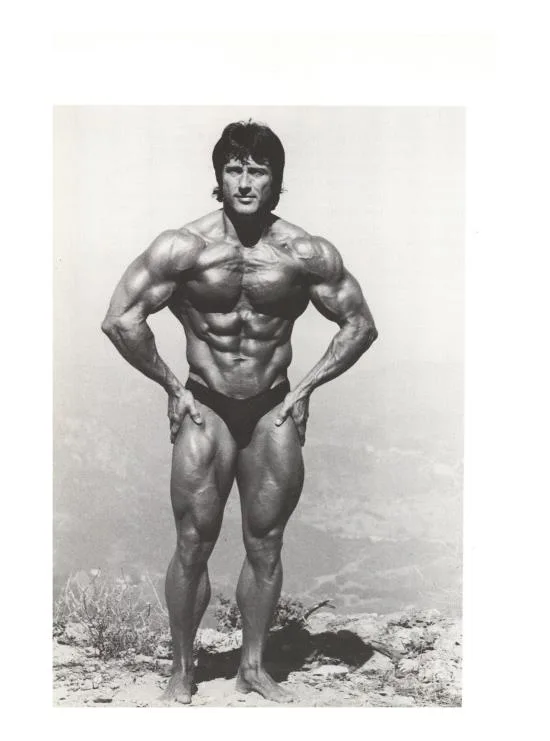
Be careful to avoid injury by always keeping warm while exercising and warming up. However, if you should get an injury, a chiropractic adjustment and/or ultrasound or sinusoidal current applied to the injured area can help. Moist heat applied to injuries, as in a whirlpool bath, is often helpful. If an area is extremely sore, I often rub ice cubes on it for a few minutes for relief. It's uncomfortable to train hard when you have a muscle injury. I found the best thing to do is to perform exercises that work the injured muscles but use very light weights and high repetitions. Thirty repetitions of two to three sets will bring a fresh blood supply into the injured area and can help healing to take place more quickly. As the injury heals, begin very gradually to increase the amount of weight used and decrease the repetitions. TANNING Nothing enhances the physique more than a deep, even tan. Lying in the sun will dehydrate you slightly, the more so in a dry climate. Gradually build up your tan over a two-month period. Use an oil containing PABA and/or lanolin and rub on an aloe cream or gel after you shower. Don't use baby oil. Avocado oil is a very good skin softener and can be used if the skin is dry. POSING Posing, or displaying the muscles of the body on stage, can be called "kinetic sculpture." To me bodybuilding is very much like sculpture because I use weight-training apparatus and nutritional principles to create my body as I wish. There are two distinct aspects of posing: tension and movement. Tension involves tensing all the muscles of the body (except the facial muscles) and holding the pose. This is the static aspect of posing. Movement involves moving gracefully and dynamically from one pose to the next. This is the kinetic aspect. Give entering competition a try. It is a great motivator. But get in shape. Don't embarrass yourself. From the Zane Way to a Beautiful Body Published by Simon & Schuster available as an eBook at www.frankzane.com