
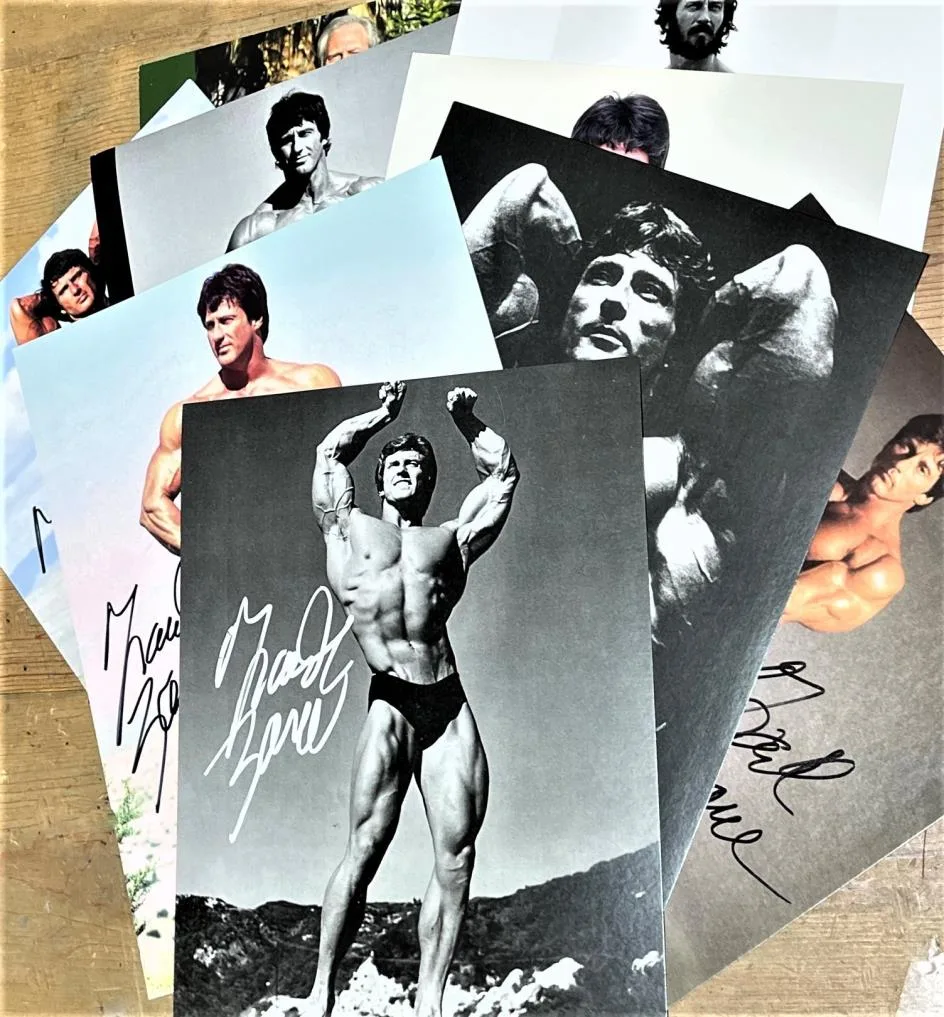
Feedback means knowledge of results and is essential for ongoing motivation. In body building if you do not know what you look like you cannot do a good job developing your body. Photos tell you how you are doing. It's the best way to measure progress period, you don't need any other way - forget scales, tape measures, calipers, they don't tell you how you look they tell you a number. For these numbers to be meaningful they need be correlated to appearance as seen in photos.
When you take photos, you record your image. As you get older your image changes - if you take photos, you will be aware of the changes. It's important to know what you look like. When you do you can do something about it.
I am glad I took thousands of photos over the years from the time I started to the peak of my training, a period of about 50 years. If I did not have Christine as a photographer (in addition to greats like Artie Zeller, Jack Mitchell, Ken Duncan) these photos would not have happened. It's important to get a good photographer. Practicing with your partner is a good idea.
In bodybuilding contests half the competitors are eliminated when the contestants show their backs to the audience. Most bodybuilders' backs lack detail because they never look at their backs. Not spending much time looking in two-way mirrors while tensing all the back muscles in the back double biceps pose, the backless bodybuilder remains oblivious to what is behind his not winning.
Moving picture filming is good too, especially to study movements in the posing routine. But here the emphasis is on movement not on the static pose, and practicing movements will not develop muscular detail. Tensing the muscles and holding the contraction for progressively longer periods of time brings out lots of little muscle details when done the last month before a competition.
When preparing for competition each night after all my working out was over, I would do a few sets of pulls in front of chest and then behind neck with rubber cables and then began selecting poses and holding them for 10 seconds, then 20, and on up to a full minute each pose. Viewing myself in two-way mirrors to see the body from all angles I concentrated on tensing all the muscles in the body at the same time while relaxing my face. After several weeks of practice, I found I could be relaxed while tensing the all the muscles. Sounds paradoxical but when I was standing around relaxed not tensing, all my muscles began to stand out in bold definition as if tensed! At this point I realized I had reached 'Muscle Maturity,' a state that occurs when you train at a physical peak for a while.
Training at high performance levels after you reach a peak turns this peak into a 'peaking plateau.' And if you can train like this for several months (or at least one month) without getting injured, you will get into your greatest shape.
A lot of change is capable of happening the last few weeks before peaking for competition. With the increased training intensity, more calorie burning aerobics, and strict dieting, the subcutaneous fat layer between the skin and muscle thins out. Veins and capillaries emerge from their hiding places only to retreat after the diet and training intensity ceases.
Photos will also give you feedback on your symmetry, i.e., how the left side of your body compares with the right side. While everybody has relative symmetry, no one has perfect symmetry. And as we grow older, if injuries develop it means you will become less symmetrical. An injury means there is a specific movement groove that you need to avoid because it may activate the injury. Keep avoiding this movement pathway and asymmetry will develop. The best course of action is after a short layoff working this injured area (3 days works for me most of the time) do the same exercise with a much lighter weight, high reps (a good 20 reps) with a slow positive and even slower negative. By slowing down the movement you increase focus, and you make the weight feel heavy enough to get a good pump. And the effect is all in the muscle not transferred on to the joint and connective tissue.
If you notice a difference in each side of your body, then take steps to correct it by doing more dumbbell work. Don't feel bad, everybody is this way. If you are a physique competitor there are ways to hide nonsymmetrical development. It's a funny thing to me that so many people say I have perfect symmetry. They say this because they don't know what symmetry means and they mistake the balanced look I developed calling it symmetry when it is really proportion. The way I overcame my differences in left/right development was to pose asymmetrically. Showing each side of the body with a different placement and angle eliminated the viewer's ability to exactly compare one side of the body with the other, so people say, 'He's symmetrical.'
You can tell the bodybuilders with good symmetry because they can hit the same pose from both sides, and it looks equally impressive. Two examples are Arnold back 3/4 double biceps pose done from each side showed his symmetry from each side. Lee Labrada's side chest from both sides is another good example.
The bodybuilding equation is based on feedback. You need knowledge of your results from training to make progress. This equation states that progress is a product of exercise, attitude, recuperation, and nutrition. Each of these areas are equally important in the sense that to make maximum progress you need to make a 100% effort in E, A, R, and N variables. Photos will give you the feedback you need to realize what progress you are making. And this feedback on an ever-ongoing basis will give you the motivation you need to be successful.